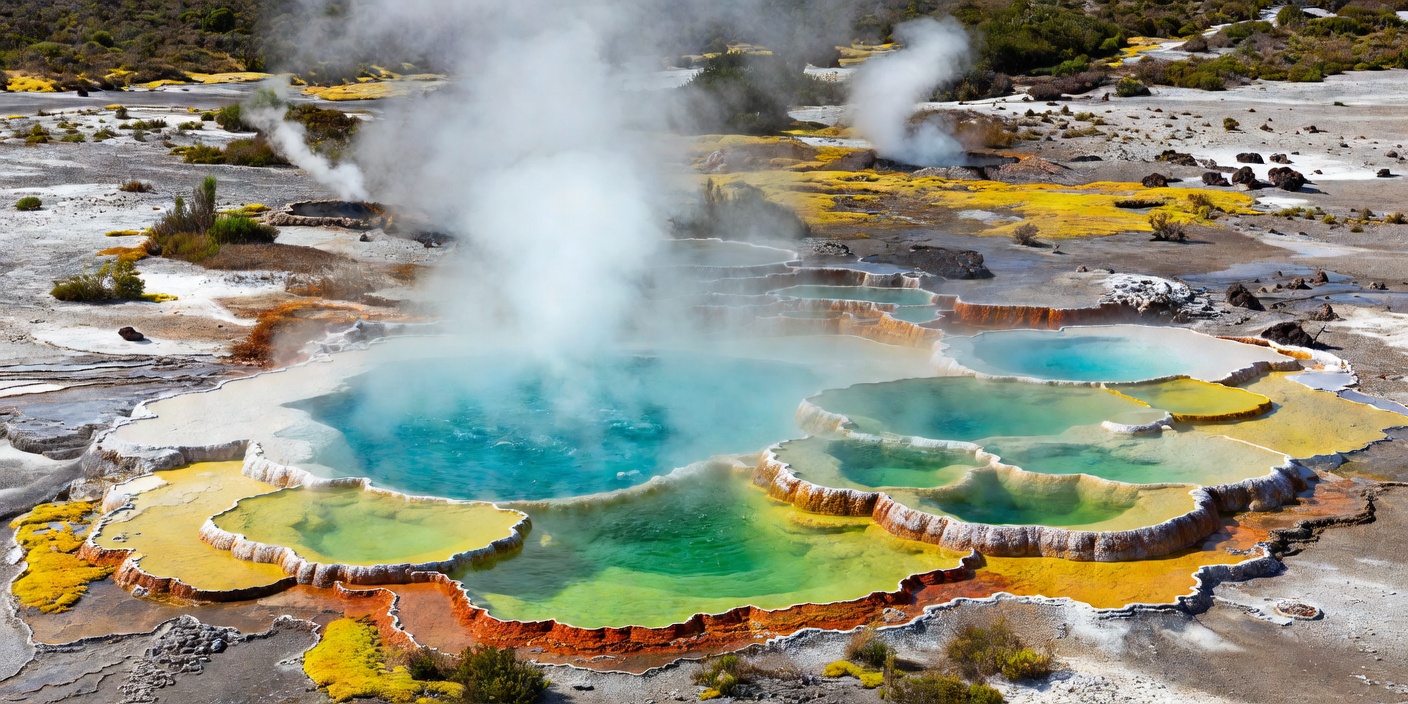
Situated directly above the dynamic Taupo Volcanic Zone, Rotorua is a landscape alive with subterranean energy. For more than 600 years, the people of the Te Arawa waka (canoe confederation) have inhabited these steaming thermal valleys, integrating the earth's natural thermal vents, mineral springs, and steaming fissures into their daily domestic and spiritual life.
The Geology of Whakarewarewa & Wai-O-Tapu
The geothermal phenomenon in Rotorua is fueled by magma chambers lying just a few kilometers beneath the Earth's crust. Groundwater seeps deep into porous volcanic rocks, where it is heated above boiling point before being propelled to the surface under intense pressure.
At Te Puia within the Whakarewarewa Valley, the famous Pōhutu Geyser ("constant splashing" in te reo Māori) erupts reliably once or twice every hour, blasting scalding water and mineral-rich steam up to 30 meters into the sky. Nearby at Wai-O-Tapu Thermal Wonderland, acidic mineral pools display surreal neon colors—from the vivid orange sulfur margins of the Champagne Pool to the electric chartreuse of the Devil’s Bath.
The Hāngī: Geothermal Culinary Masterwork
Unlike standard hāngī pits which require lighting a wood fire to heat volcanic stones, the residents of the living Māori village at Whakarewarewa utilize natural steam vents (*ngāwhā*) and bubbling hot pools (*parekohuru*) as direct ovens. Food wrapped in baskets—such as pork, kūmara (sweet potato), and pumpkin—slow-cooks to buttery perfection in the mineral steam.
Te Puia & The New Zealand Māori Arts and Crafts Institute
Established by an act of parliament in 1963 to prevent the loss of traditional Māori carving and weaving techniques, the New Zealand Māori Arts and Crafts Institute (NZMACI) at Te Puia trains master apprentices from across the nation in:
- Whakairo Rākau: Traditional wood carving utilizing tōtara timber to craft meeting house (*wharenui*) pillars and ocean-going waka.
- Te Rito Harakeke: Weaving flax fibers to craft intricate *kākahu* (feathered cloaks) and *piupiu* kapa haka garments.
- Whakairo Kōhatu: Bone and pounamu (greenstone/nephrite jade) carving representing ancient ancestor lineages (*whakapapa*).
Cultural Etiquette for Visitors (Tikanga)
When entering a traditional marae (sacred communal meeting ground), visitors undergo the *Pōwhiri* (welcoming ceremony). Respect the protocols: remain silent during the *karanga* (ancestral call), do not walk across the central ceremonial courtyard (*marae ātea*) while speeches are occurring, and remove footwear before stepping across the threshold of the *wharenui*.